Thursday, July 26, 2018

Single Malt or Narangi?


The Good Book says, “Man does not live by bread alone”. With all due respects to the Holy Bible, fact is, a man or a woman needs a drink too, not only to wash down that bread, but to generally relax with. Better still, when there are friends around to break bread with and share that drink. With this guiding aim, we set about getting the party going on the 21st of July.

Now in any organisation, there are planners and there are go-getters. I am a natural born go-getter. I received a series of rapid fire instructions: “Go get the balsamic vinegar, go get the cherry tomatoes, go …., go …., go …. Like most husbands, I usually remember only the first three commands. That explains why in all American cop movies, the police Sergeant barks out three times Go, go, go! 

By around 1830, I set about mixing the ingredients of the three cocktails I had planned. I had to do so in the kitchen, much to the chagrin of the two maids, who took a dim view of the intrusion into their space. Nevertheless, they provided me with a steady supply of items like diced peaches and apples, sliced lemons, cleaned and plucked mint leaves and even struggled to comply with my more exotic requests like spirally cut orange peels.

Suddenly, I froze. This wasn’t happening. The cranberry juice ran out even before I could get started. The twins rose magnificently to the occasion. Kamakshee was on it even before I could say Bloody Mary. The offending juice was produced in 5 minutes flat. I unfroze.

I reached for the ice tray, only to find that the water had stubbornly refused to freeze. I glared around. I could see poor Madhav’s face crumple. “But I put the water in the trays in the morning”. Notwithstanding, in no time at all, he produced a large bag. Cavalry to the rescue!

It was almost time. The Memsahib emerged, fixing the general arrangements with a critical stare. Some instructions were snapped out. A few minor adjustments later, she settled down to take a few snaps.

Vidur emerged in a cloud of after shave, looking scrubbed and fresh as a daisy for the evening shift. For a few moments, he gazed wistfully at the table, then sampled a few snacks. Finally, he gathered up his things and left. Duty beckoned.

The doorbell rang – looking casually chic and wearing coordinated outfits, were Mrinalini and Naren Chaudhary. We have been regulars at their elegant home on so many occasions for elaborate Ganesh Pujas and since either one of them are usually travelling, or, sailing as in Naren sir’s case, we were fortunate to have them both together. Mrinalini is a single malt person, but she sportingly agreed to try my concoctions. Naren sir, being an old salt regarded the colourful liquids with some suspicion, then steering clear of uncharted waters as seasoned mariners do, stayed with his favourite whiskey.
Probably one of them reminded him of a country liquor known by it’s colour, Narangi!

A few minutes later, another Chaudhary walked in – Abhijeet, smiling shyly, minus his better half, Bharati. Bharati was visiting relatives in Chicago. Abhijeet, instead was forced to make do with E Block, Jal Vayu Vihar. Somehow, I knew that Abhijeet, being another crusty old sailor, would also prefer whiskey. Very soon the two Commander Chaudharys were chatting away, content with their juices.

The doorbell rang again – tall and graceful Kawal, accompanied by a dapper PP Singh in a smart sand coloured jacket neatly coordinated with his turban, entered. Suddenly, the room appeared to be filled with tall people. It was time to leave the door wide open and I busied myself with the drinks.
When I turned back, all I could make out was a flash of bright light entering the door, albeit at a lower level than the aforesaid couple. The bright light was from a face with a dazzling smile. Ever youthful, Bindu and Suresh Nair had entered. Bindu agreed to try one of my colourful contraptions, but it was plain that it wasn’t quite her cup of tea. Nevertheless, she valiantly knocked it back before switching to her favoured drink. Suresh, in the meanwhile enjoyed checking out various cocktails, before he settled on a Blue Lagoon. 


Decibel levels that had risen considerably, particularly in the feminine voice range, suddenly dropped. The wall-clock paused. Traffic on the road also stopped. Glasses of single malt on their way to parched lips stopped in mid-flight. Komal, pretty and tall, and every bit a show stopper, dressed to a fault, made her way in. She arrived alone, her husband, JP was working late. Then the shor-sharaba resumed, feminine Hi’s and Hello’s were shrieked out. As I handed Komal her drink, she reminded me that I hadn’t given her the recipe of a cocktail she’d liked and requested over a year ago. I mumbled some inane reply. A pretty woman and a focussed mind can be a formidable combination.

I glanced at the cocktail jugs in surprise. The levels of all three were going down pretty fast.

Just then I felt the vibes and looked at the door. Most people walk into a room and are observed. A few can make an entrance with ease. And there are those, whose aura precedes them. Neelima is one such special person. There she entered, grandly, like a Duchess, smiling with her eyes. She sailed into the room, wished me, took in the changes in the room decor and launched into a conversation with the Memsahib and the rest of the room, all in one breath. Complimenting her eminently, my buddy Lokesh, impeccably dressed as always and could have passed off as a Duke had he been wearing coat tails and a topper. He grinned at me quietly through his beard, while I tempted him with a Caipiroska. I knew that smile, it was from a fellow member of the “Talkative Wives, Quiet Husbands Club!”

Nalin and Dimple, our neighbours from upstairs, also joined in. They had just returned from a hectic trip to Delhi, and I was pleased they were able to make it. Just then the ice ran out. Nalin sir, gallantly offered to run upstairs and fetch some more. I buzzed Jakes as well, asking him to get some ice too. For a long time, Nalin had been tagged by the twins as the ‘Sunny Deol Uncle’, for his resemblance to the movie star, only better though. A few drinks down the road, Dimple could have been persuaded to recite some of her exquisite poetry, but today time was short and as Karen Carpenter said, we'd only just begun!

I was beginning to wonder whether Jakes and Asha had other plans, when they walked in, in a fizzy cloud of effervescence, raising the decibel levels still further. Jakes, my bro from another Mo, knew he could take some extra liberties with me, while Asha smoothly palmed off the blame for their late entrance to her husband. Both had a lot of catching up to do in the drinks department. Jakes is a wine purist, so I knew there was no point even asking him, but Asha was ready to plunge into the Blue Lagoon, indeed matching the blue of her dress. I handed Jakes the bottle of wine and asked him to bash on regardless.

It was difficult to count, but from the general size and spread of the crowd, some of whom were standing in the lobby outside, smoking, it appeared that all those who ought to be there, were there. I busied myself preparing a fresh reload of “Sex On The Beach”, to keep the spirits from flagging. In an effort to be politically correct, I had named that brew, “Day At The Beach”. I must have gotten something right, or else everyone was being extra polite and tossing back the drinks with relish, for the “Beach” had nearly beached and the Blue Lagoon was going down soon. Between darting in and out of the kitchen, I had a vague idea that someone else had arrived but I couldn’t see through the throng of people crowding the main door. 

Was that a flash of someone’s coloured hair? And then she entered – Taruna looking very Sector 17 Chandigarh and South Delhi together, followed by Birdy with his signature casually hep style. Birdy had made it back from Moscow and almost without a break or rest, they had promptly come over, a commendable effort! To be honest, I don’t remember whether I actually offered them a drink or I forgot, but I knew it was fine, they’d make themselves at home. 

The last of the Glenlivet was drained away. The Vat 69, my personal favourite, stepped forth like an old soldier, ready to do duty for king and country. Someone opened the Red Label and sniffed it first. Once confirmed that it was the real McCoy (and not a country-cousin of Narangi), it was soon splashed into various glasses. I discovered that I had lost my own drink for the third time. I wasn’t certain if someone had obligingly finished it off, or, had I just put it somewhere and forgotten about it.
It was getting time to move to Rodas. It was decided to launch the twins first as they were getting restless, and they were duly despatched to keep the staff there occupied until the main force arrived after another couple of rounds. But the party was in full swing and spirits were soaring. Question was, how to get them moving.

I remembered reading that people even in late adulthood respond to stimuli from childhood. I knew that the entire male population present had heard the ‘Last Drink, Dinner Call’ several hundred times in various Messes and Ships, so I decided to use the Memsahib’s dinner bell to invoke long forgotten memories of the bad, young days. Clearly, it worked, for there was a chorused reply of “We have 15 minutes more” undoubtedly practised to perfection in bygone days by younger versions of present company! Amazing how as juniors, we enforced our rights in the unlikeliest of places. 

Coming back to the present, cheeky responses like “Bugger off” and “Get me another two large ones before dinner” were duly ignored.

Kamakshee called from the hotel clearly peeved at being kept waiting. We decided to get everyone moving, lest we face a mutiny in the household cavalry. Slowly, the crowd began to shuffle out, pausing at my wicket gate for the ubiquitous selfies. Everyone wanted to get into the pic in the narrow doorway. I held my breath as a shapely stilettoed leg clambered on to a folding chair, near the door, so that the pretty face at the other end could be part of the pic. Luckily the chair held out and the stilettoed leg, pretty face and their owner safely dismounted.

Everyone had filed out and were finding their way into various cars for the short ride to Rodas. The Memsahib surveyed the room in the manner of Admiral Chester Nimitz surveying the remains of his fleet at Pearl Harbour. I knew what she was thinking - Just as Nimitz is reported to have remarked, “It’s a good thing the Japs attacked on Sunday, when there were few men onboard”, she was thinking, “Good thing the dinner’s at a hotel. Less cleaning up”. However, like all great strategists, she never revealed her mind.

“Go get the car”, was all she said instead.

Monday, February 12, 2018

Why We Don't Need More Women Fighter Pilots


This article does not intend to debate on the suitability of women as fighter pilots. However, if we are to improve the lot of women, we have to go beyond shop window exercises aimed at grandstanding. We need to address the real issues concerning underprivileged women, who reside at the bottom of the economic pyramid. The Govt needs to give these women encouragement to do things that they can easily achieve, and, which will improve their lot economically, rather than dangling fruit that are difficult to reach for the vast majority. 

Some years ago, on Republic Day 2014, the nation was treated to the sight of a contingent of smartly uniformed women officers from the three services, marching ahead of the columns of men from various regiments. The idea was ostensibly to protect women power. No one questioned why the women officers were carrying rifles like jawans, and not swords as officers normally do. This could imply that as officers, they were being placed on par with the men they are expected to lead. That was another matter, but let that pass. Around the same time, the media went to town about a lady Air Force officer who commanded the honour guard for President Barack Obama during his India visit.

The media as expected, waxed eloquent about how another glass ceiling had been broken and women were emerging in a new India and so on. This was simply another red herring to deflect from the real issues plaguing women. As far as commanding the Guard of Honour was concerned, there was never a glass ceiling, as all officers, whether male or female, are expected to perform a variety of routine tasks. Barking out drill commands to a body of soldiers, during peace time, is certainly nothing exceptional. Armed Forces officers do it all the time.

The issues concerning women have a great deal to do with a class of people who are least concerned about women marching along or even becoming pilots. These people are at the opposite end of the pyramid from those who can qualify as fighter pilots and it is issues like safety, hygiene, health, education, food and nutrition that concern them.

The women who can aspire to be fighter pilots are well educated and come from relatively well to do households, where there is far more freedom given to growing young girls to dream big, as against homes where their dreams and aspirations are not only prevented from growing, but both boys and girls are brainwashed into fulfilling stereotyped roles from an early age. Those who live at the base of the pyramid also have to contend with hostile male dominated environments every day of their lives with little hope of succor from a society and police steeped in the belief of male superiority. Since India's feudal mindset decrees that as it the boy who must grow into a bread winner, it is he that needs to be groomed, educated and nurtured for his future role, while the girl child is taken for granted, as her only role would be child bearing, rearing, home cleaning and cooking, none of which require any formal education beyond primary school level.

On the other hand, women military officers function in a highly disciplined, closely monitored environment, where infringement particularly by their male colleagues invites swift and sometimes harsh punishment. Military leaders in their ingrained desire to not only do the right thing, but also be seen to be making the right moves and noises, frequently go out of their way to create an artificial environment to ensure that the woman officer makes the grade and is seen as a model of success.

One of the important reasons for slow changes at the level of the less privileged is the lack of opportunity for women to contribute economically to society. It is possible to improve conditions for women if there are reachable avenues for women to take up jobs and professions. And this applies equally to cities as it does to small towns and villages. Certainly, there are shining examples of women who clawed their way out of poverty and retrograde mindsets to earn international acclaim, but those are so few. Further all these women had the backing of families who wanted them to pursue education and were able to find the ways and means to do so. But not everyone can.


Women who can aspire to be fighter pilots can equally aspire to be bank managers, doctors, or Govt officers or airline pilots - simply put, they have multiple choices they can pick from. However that is not a luxury available to women from poorer sections. So there is little to be gained from putting up posters of women in flying suits, with the aim of motivating women from there.

It is like showing an average factory worker the glossy pamphlet of a house costing several crores. He would like to live there, but he knows it is futile to even think about it, and would rather see something he can reach.

Putting it differently, we have to create a sufficient number of low hanging fruit that most women can pluck.
Women's safety has often been cited as a reason for women not going out to work. So why not create a scenario where there are many more women out working. Why not create a situation where the boys at the same economic level have to compete with their sisters to get the same job, rather than competing only with other boys.


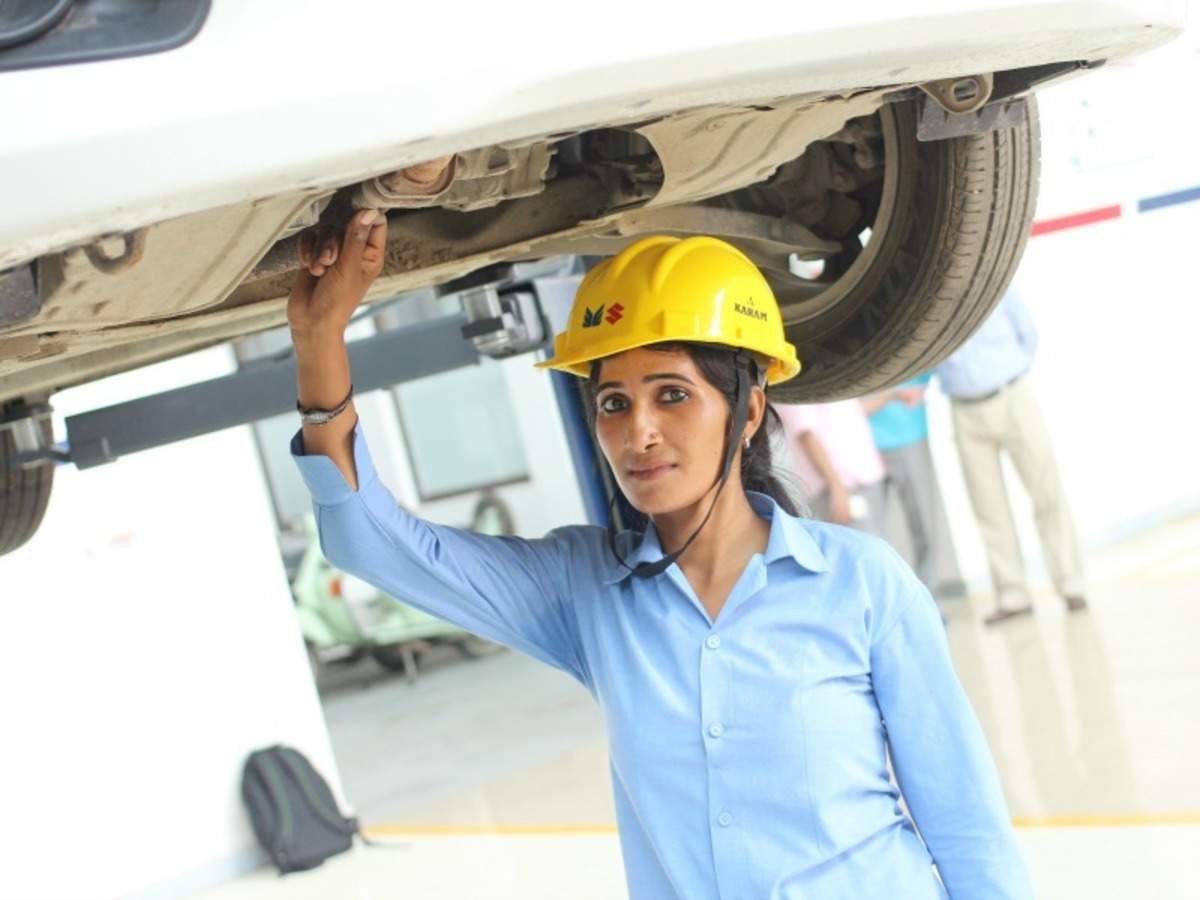
Can we not set apart a portion, say 30%, of taxi driver licences, for women? Similarly for auto rickshaw driver licences. Why not bus drivers and conductors? Why can't more women become electricians, plumbers, mechanics, carpenters and masons? Why can't more seats be reserved for women in the ITIs and other institutes imparting technical training? And similarly for other professions as well.

If this could be done, there would be more women out on the roads and women's safety would improve through numbers. Women are more comfortable taking an auto driven by another woman. At present, there are hardly any women auto drivers in Mumbai . Further, once parents from poorer sections realise that their daughter is capable of earning without their having to spend large sums on education, they would encourage her to complete some basic education, perhaps at least till Matric. Just as nursing has come to be regarded as a women dominated profession and parents in Kerala encourage their daughters to study enough to get a job as a nurse, so should it be for many more professions.

It would also reduce the pampering of the boy child as he would now have to study diligently to avoid the ignominy of having to take up a menial job, while his sister succeeds as a trained technician. Most importantly, it would contribute to the self worth of the girl child, when she has her own well-earned money in her bank account.


This, in my view, is a better way of improving the lot of women in society than training a privileged few as fighter pilots.


Thursday, December 21, 2017

The Reality Check

The Reality Check
By Kris Tee
On impulse, I decided to take a train. Tickets were available and although it was several years since I had taken an overnight train, I thought it would be fun. The others were all going by air. Perhaps it was the steep cost of the air tickets that was the decider.
I was not familiar with Bandra East, much less Bandra Terminus, having last boarded a train from there nearly ten years ago. It was therefore a shock to see the area around the station – narrow bumpy roads crowded with all manner of vehicles, which is true of most of Mumbai. However, this place seemed to have been bypassed by the BMC when beautification was being done. Could they not have chosen a better locale for the station?
Why do the railway lines pass through some of the most squalid areas of the city? Or putting it in another way, why do we subject our train travellers to some of the filthiest visuals of the city, when we go to great lengths to beautify the area around the airports? Why do we believe that railway passengers deserve to see the reality of the city’s dirty underbelly while air passengers should see waving palms when they exit the cool of a plush, modern airport? In Switzerland, as in other parts of Europe, pretty houses adorn the area adjoining the railway tracks and some of the most stunning scenery can be seen while travelling by train.
I entered the station, dodging the urchins, beggars and touts that seem to inhabit every station in India. There were less coolies than earlier, but very much there, nevertheless with their distinctive red shirts, carrying luggage on their heads as they have traditionally done. I looked for the typical railway over-bridge to cross the tracks to platform 5, but could see none. Then I noticed the signboard for the subway – now that was a first – a subway to cross railway tracks. As I entered the rush of bodies moving along slowly, I noted the variety of luggage - wheeled suitcases, canvas and nylon hold-alls perched on shoulders and heads of their owners, baskets filled with food, plastic shopping bags with names of quaint shops prominently displayed – Dulhan Sari Emporium Kanpur, Lovely Garments, Dadar (TT), Specialists in all Ladeez Wear, stuffed with the outcome of the last shopping expedition.
Just as I began to assume that all life at the station was slow paced, I was treated to the sight of a short, bow-legged plump woman, clutching a bag, running past with anxiety writ on her face accompanied by two children trotting along behind her.
It certainly was a reality check, reminding me that all journeys were not restricted to the Mumbai – Delhi flight, that there existed a world beyond Terminals 1 and 2 of the airport, replete with its unique sights, sounds and smells, blinking tube-lights covered with soot, and overflowing drains over which passengers stoically stepped and which station staff seemed not to notice at all.
The railway station is certainly a great leveler, whether you are travelling unreserved 2nd class or AC 1st Class, you must endure the station and its in-your-face accompaniments. That goes with the territory and you can’t avoid them, till your train arrives, that is. Then you can see agility on display as those without reserved seats scramble and struggle their way into the designated coach. I wonder if Shashi Tharoor had ever seen the inside of such a railway coach, when he made that infamous “cattle class” wisecrack.
I entered my AC 2 tier coach, only to find it hot and stuffy. The a/c hadn’t been turned on yet. I promptly exited the coach leaving my things in the care of the person occupying the upper berth. Only in a railway compartment in India, can you leave your luggage in the care of a complete stranger who will cheerfully accept its temporary charge. I picked up a bottle of water, some biscuits, a cup of tea and one for my new-found friend. Meanwhile the compartment began to fill. A woman seated nearby looked at me and said something in Gujarati, which I understood to be an enquiry of my destination.
As the train began to move, khakras and theplas emerged. They generously shared their food with me. I had nothing to offer except my biscuits, which they politely declined. At Borivili, an elderly lady joined the compartment. Introductions were made, she was travelling to Rajkot, as were the other couple. She explained that she had gone to Pune to visit her son and was now returning home. The couple was returning after attending a wedding in Mumbai. For a while they discussed how awful life in Mumbai was, and how glad they were to be going home. They discovered common friends and the elderly lady described her home in Rajkot and the area that she lived, while the man addressing her as Kaki, told her he was in the transport business and that she could call him whenever she needed a car.
They wanted to know why I, clearly not the regular train-traveller, was going to Jamnagar. It sufficed that I was working in a private company and was going for a meeting. I wasn’t sure that I would be able to explain that as a former Commodore, I was travelling for a reunion at a Naval base.
They had their dinner before me, while I waited for the train to reach Surat for my dinner. Once again they courteously offered me their food. Dinner over, the man bought a bottle of milk each for his wife, the elderly lady and himself. The elderly lady declined, but he prevailed over her protests, taking off his cap and bowing his head for her to bless, saying that she was like his mother and as she had blessed him, she ought to accept the milk.
I saw the reality of middle-class India at its finest. Perhaps nowhere else in the world can one witness the trust, affection and camaraderie among people who, till a few minutes before were complete strangers.

Despite the fast pace of our busy lives, the cacophonic traffic, the surging crowds and the lack of privacy in the major cities, thankfully the spirit of India thrives in the myriad smaller towns and villages. The railway journeys bring out the best.

Saturday, December 17, 2016

Remembering

Remembering
Yesterday was Vijay Diwas. 
I wonder how many even knew what that was. For those who didn’t, it was a day of remembering; remembering events that took place a lifetime ago. More importantly it was a day to remember the people who made things happen during those fateful 14 days. 
We try to cling to memories, but the realities of life become all pervasive and memories of those eventful days begin to blur. I was a schoolboy then, and my only recollection of the ’71 War were the blackouts and the bold headlines in newspapers. It was the twilight of my father’s army career, and my elder brother was still at the academy, so the war was far away for me. It was only much later I understood that my father’s younger brother, at that time was leading a brigade into what became Bangla Desh, while a cousin was with his infantry battalion elsewhere. 
There were thousands of other families affected in one way or another, but I was simply too young to appreciate the intensity with which the war had pierced so many households.
During the intervening years, I went through my own career and began to see things a little more clearly.
With electronic and social media becoming penetrative, and with the impossible pace of life in all spheres, it is easy and convenient to place a ‘Like’ on a catchily captioned photo of a wreath laying ceremony at India Gate, and then move on. 
You have, after all, done your bit to ‘remember’ Vijay Diwas and the blurred picture of the surrender ceremony.
But let me describe to you in another way, how you can perhaps do justice to those hazy memories.
Spare a thought for those hundreds of soldiers, sailors and airmen who went out to do their duty unsure of what lay ahead and perhaps more than a little nervous with anticipation. Were they scared? Very likely. Did they think they would never see their families again? Surely many of them did.
Most returned, thanking their gods, to reunite with their families. But there were many who returned without a limb, or with horrible injuries, scarred for life, unable to carry on with their lives in the way they had just a week or ten days earlier. There were even many who never returned.
Spare a thought for their grieving families – lives cast adrift in the ruralscape of India, young widows forced to marry against their wishes, younger male members of the same family. Elderly parents barely able to care for themselves and now forced to look after a daughter-in-law and grandchildren. Uncertain, insecure wives with scared children.
Try to picture the hellish situation in which young Arun Khetarpal must have found himself, in a solitary, crippled tank with bombs exploding around him and no one to turn to for help. And now imagine how he must have gritted his teeth forcing himself and his crew to stand fast and fight on in a burning tank to certain deaths. 
Remember the stubborn determination of Kuldip Singh Chandpuri, as he struggled to hold his ground at Longewalla, desperately fighting with his meagre resources against a vastly superior enemy. Think of his cool professionalism and stoic leadership as he carefully used every piece of knowledge of fieldcraft to his advantage while praying for air cover knowing that he couldn’t hold out for ever.
Think of the single minded determination of Nirmaljit Singh Sekhon, the dogged leadership of Hoshiar Singh and Albert Ekka and dozens of others who were ordinary soldiers – drivers, gunners, riflemen, signalmen, doctors, engineers, aircraft technicians, mechanics and others who simply did what was expected of them, praying for an end to the madness and their own safe deliverance.
Try to picture the sheer terror in the darkened engine room of the dying Khukri and the desperate struggle for the last breath of air as trapped men saw the water rise around them. Try to hear their hoarse screams as they struggled to breathe, till one by one they fell silent and the only sound was the sea rushing into their lungs.
Now try to imagine the steel in the eyes of their captain, as he struggled to get his men off the sinking ship, till he knew it was impossible with dozens of men trapped in the bowels of the ship. Picture him sitting there in the Captain’s chair in his peaked cap with a lighted cigarette literally looking death in the face as the ship sank under him. Imagine the courage it took to sit there while the sea swallowed him.
In those four minutes, Mulla taught generations of Indian soldiers not only how to live but also how to die. He showed by example that it was completely possible to live up to the Chetwodian motto of placing one’s life last.
Imagine the sudden silence of the dark night four minutes later with yourself bobbing in the vastness of the Arabian Sea, with perhaps a few faint cries for help from the darkness.
My dear friend, if you can stretch your imagination to picture all of this, however briefly, you would have done a great service to all those soldiers, sailors and airmen who went out to do their duty, and, their families who stayed back and prayed.
For that, is what Vijay Diwas is all about.
Remember them.

Friday, August 19, 2016

Security Of India’s Offshore Assets

Security Of India’s Offshore Assets
Challenges and Opportunities
By
Cmde Sanjay Tewari, retd, Business Head, CISB Technologies Pvt Ltd
(Article Written For A&S INDIA)

India’s land border on the western front is well demarcated, illuminated and fenced, where feasible. In contrast, the maritime border is neither visible, being only a line marked on navigational charts while another line 200 nautical miles seawards, demarcates India’ Exclusive Economic Zone (EEZ) where India has exclusive rights to oil and gas exploration, drilling, mining for rare minerals, fishing and any other form of economic activity.
The EEZ covers a sea area of roughly 2.7 million sq km, which, in perspective is nearly three fourths of India’s land area. Within the EEZ various companies, both state owned and private have been awarded blocks for the exploration and exploitation of hydrocarbons. These areas are collectively known as the Offshore Development Area (ODA).
In the Western ODA, the farthest field lies 160 Km into the Arabian Sea. There are 13 process complexes, 214 well platforms and 25 – 30 rigs or drill ships. In terms of economic investment, ONGC alone has pumped in close to $ 27 billion. The offshore fields currently produce 25% of India’s demand for crude. On the east coast, the offshore produces 75% of India's demand for natural gas. Clearly, the offshore is a vital area from the point of monetary investment and maintaining India’s energy security.
The threats to the Offshore are numerous and ever changing – apart from the possibility of infiltration and sabotage from inimical elements, and physical occupation of platforms, which are obvious, a vigil also needs to be maintained against hijacking of vessels, deliberate collision by ships against platforms, vandalism and damage to unmanned platforms, damage to pipelines at land-fall points and attack by hostile craft, among others. This requires that all ships and boats operating around platforms be observed closely.
In order to better monitor movement of ships and boats, a number of networked radars are installed on offshore oil platforms to provide a composite maritime picture of the entire ODA to the navy. This surveillance is backed up by armed patrol boats maintaining a physical presence in the area. The sea area of the ODA has been placed off limits to shipping, with general ship traffic being re-routed around the ODA. Vessels entering the ODA for legitimate purposes are required to obtain permission from the GOI before they are permitted to enter. This includes a physical verification of the vessel and crew by the Navy.
Vessels displacing more than 300 tons are required to have Automatic Identification System (AIS) transponders installed, that provide essential ship identification information when interrogated. Thus at any time, the Navy is aware of the credentials of all ships inside the ODA. Ships that do not fulfill the security criteria, or are observed to be straying from their designated courses are visited by the prowling patrol boats. Backing up the patrols are Naval and Coast Guard aircraft and ships. While entry and movement of ships has been effectively controlled and monitored, security imperatives are complicated by the presence of numerous fishermen in their small boats.
During the fishing season, there are literally hundreds of boats, none of which have AIS transponders. Although a zone of 500m around the oil platforms and rigs has been designated as a no fishing zone, fishermen have been found fishing in the immediate vicinity of platforms, since fish are attracted by the lights of the platform and the gas flare at night. Many of these fishermen have no I Cards. While the GoI has embarked upon an ambitious program to issue Smart Cards to all sea going fishermen, only about 20 lakhs have been issued cards, which still leaves a number nearly four times larger waiting for Smart cards. Similarly smart card readers are also required in large numbers, with each patrol boat requiring at least one reader.
Vandalism by fishermen at night on unmanned platforms is a perpetual problem as they tie up their boats quietly and use the platform for cooking and sleeping and in the process help themselves to copper or other valuable materials. While it is feasible to install movement detectors and cameras, the information cannot be sent in real time as it is done on land. While on land it is feasible to use GPRS to transfer information in real time, SIM cards do not work beyond a few km out to sea. Similarly, the manned platforms need measures to warn them of approaching fishing boats since it is not possible for patrol boats to be everywhere.